
We built a tool that grew our traffic 178,000%
Then we rebuilt it for everyone
WISEROWS started as an internal growth dashboard that became a Frankenstein of 44+ pages. It drove insane results — so we rebuilt it from scratch as the platform we wished existed.
Real results from using our own tool to grow WisePIM over 12 months
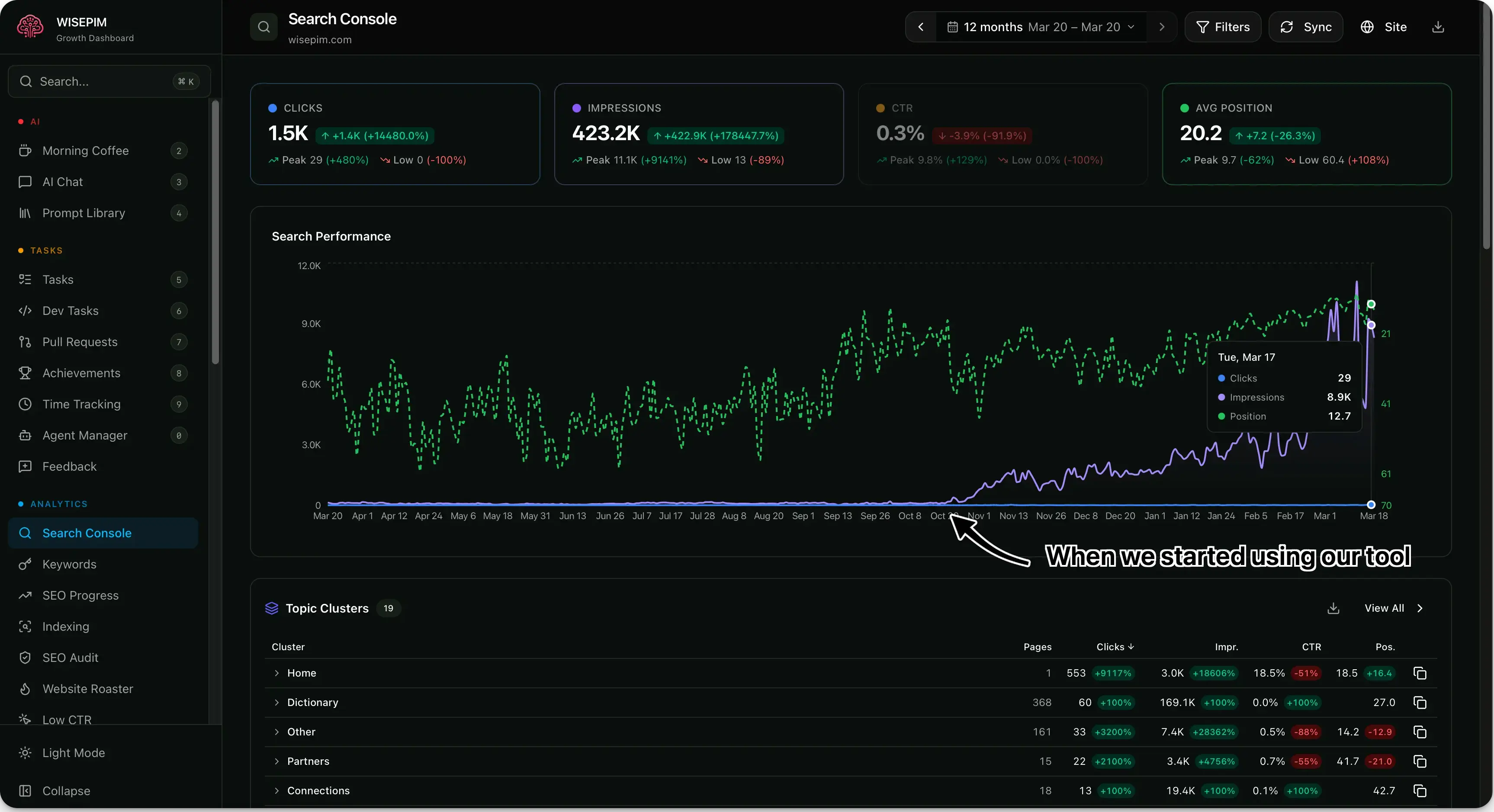
The actual growth dashboard that powered these results — and the direct predecessor to WISEROWS
The origin story
It turns out we're really good at two things: content generation and data structures. At WisePIM, we built AI-powered tools that help e-commerce companies enrich, translate, and publish product data across thousands of SKUs. We solved their content problems at scale.
But as a SaaS company — not an e-commerce company — we wanted that same power for ourselves. We needed to generate glossary pages, comparison articles, blog posts, and marketing content. Track our SEO. Analyze competitors. Manage leads. So we started building an internal growth dashboard.
That dashboard just kept growing. 44+ pages. 20+ AI chat tools. Integrations with Sanity, PostHog, Attio, Google Search Console. Competitor analysis, SERP tracking, content ROI, A/B test tracking, automated publishing — the works. It became a powerful Frankenstein.
And it worked. Over 12 months, we used it to grow WisePIM's organic presence from nearly zero to 423K impressions and 1.5K clicks per month. Impressions up 178,447%. Clicks up 14,480%. Average position improved 8 spots. All driven by programmatic content generation, systematic SEO tracking, and AI-powered optimization.
But every time we wanted to add a new content type, we had to write a new router, a new database table, new UI pages, and new AI prompts. The core pattern was always the same: define a schema, generate content, manage data, publish. So we rebuilt everything from the ground up.
WISEROWS is the multi-tenant, productized version of that 44-page growth dashboard. But somewhere along the way, we realized it wasn't just an SEO tool anymore. The underlying pattern — build a schema, manage data, improve it with AI, visualize the results — works for any dataset. So that's what we built.
It started as an SEO tool. It became a data engine.
The SEO results were just the beginning. We realized the underlying pattern — build a schema, populate data, improve it with AI, visualize the results — applies to any dataset, not just content.
Build any schema
18 field types. Drag-and-drop builder. Model products, leads, articles, competitors, research data, inventory — anything with structure. Your schema drives the entire system: tables, forms, AI prompts, integrations, and dashboards.
- Text, numbers, dates, selects, relations, formulas, AI-generated fields
- Table, kanban, gallery, and calendar views
- Schema as the single source of truth
Edit at speed
Inline editing, bulk operations, keyboard shortcuts. Select 200 rows and update a field in one click. AI enrichment runs as background jobs so you keep working. The UI stays out of your way.
- Inline cell editing with auto-save
- Bulk update, delete, enrich, and export
- Background jobs with progress tracking
The most powerful filters
Every field type gets its own filter. Text search, date ranges, select dropdowns, number ranges, empty/not-empty checks. Combine them freely. Save as named views and share with your team.
- Column-specific filter types (not just text search)
- Saved filter presets as named views
- Global search across all visible columns
Visualize in dashboards
14 widget types. Drag-and-drop layout. Connect widgets to your entity data, analytics sources, or SEO metrics. Dashboards aren't read-only — they link back to the data so you can improve it directly.
- Bar, line, area, pie, scatter, radar, and 8 more chart types
- Drag, drop, and resize with per-user layout persistence
- Click through from chart to underlying data
The cleanest UI we could build. We obsess over every pixel. No clutter, no feature bloat in the interface. Power features are there when you need them, invisible when you don't. Data tools shouldn't feel like enterprise software from 2010.
How we got here
The e-commerce years
Building custom solutions for e-commerce companies at WisePIM. Solving product data enrichment, translation, and multi-channel publishing for thousands of SKUs. Learning every pain point firsthand.
The internal tool
As a SaaS company, we wanted for ourselves what we were delivering at scale for e-commerce. So we started building an internal growth dashboard — competitor analysis, SEO tracking, content generation, analytics. It grew to 44+ pages, 20+ AI tools, and integrations with Sanity, PostHog, Attio, and Google Search Console.
The Frankenstein moment
The tool kept growing. Every new content type meant a new router, database table, UI pages, and AI prompts. The pattern was always the same: define a schema, generate content, manage data, publish. We had a powerful Frankenstein — but the core pattern was screaming to be generalized.
WISEROWS is born
We rebuilt everything from the ground up as a generic, multi-tenant platform. Entity types replace hardcoded data models. Prompt templates replace hardcoded scripts. A smart AI chat ties it all together. Today it includes 14 extensions, 14 dashboard widget types, SERP tracking, keyword management, workflows, and a knowledge base.
What the internal tool proved
Every feature in WISEROWS was battle-tested on our own business first.
Programmatic SEO works
500+ glossary pages, comparison articles, and blog posts — all generated with AI, reviewed by humans, published to Sanity.
Data-driven content wins
Tracking every page's clicks, impressions, and position let us systematically improve content that was close to ranking.
AI + human review scales
AI generates the first draft. Humans review and approve. This workflow produced 500+ pages without sacrificing quality.
ROI tracking matters
Knowing which content drives conversions changed how we prioritized. Content ROI tracking paid for itself immediately.
Internal tools compound
Every feature we added made every other feature more powerful. SEO data informed content strategy, which fed analytics, which guided the next batch.
The pattern is universal
Schema → generate → manage → publish. It works for glossary terms, blog posts, leads, tasks, products — any structured data.
Meet the founder
The person behind the Frankenstein dashboard — and its proper reincarnation.
Diego Nijboer
Co-Founder & CTO
Full-stack engineer with expertise across frontend, backend, and AI systems. Co-founded WisePIM, where he architected AI-powered product data tools for e-commerce at scale. Built the 44-page internal growth dashboard that proved every feature in WISEROWS. Obsessive about performance, UX, and building technology that feels fast.
What we believe
Simplicity first
Powerful tools should not require a PhD. Every feature is designed to be accessible from day one, with complexity available when you need it.
Data ownership
Your data is yours. We provide the tools to manage, generate, and publish — but you always retain full ownership and control.
AI as a collaborator
AI should augment your workflow, not replace your judgment. Generation and chat always include human review and approval.
Open ecosystem
No vendor lock-in. WISEROWS integrates with your existing stack — CMS, analytics, CRM, automation — so you can adopt it incrementally.
Frequently asked questions
From the makers of WISEROWS
Running an ecommerce catalog? Meet WisePIM.
WisePIM is our flagship PIM platform built for retail and ecommerce teams. Enrich and translate your entire product catalog with AI, sync to every sales channel, and make your PIM smarter — not harder.